Trading confluences explained in 18 minutes for traders building a repeatable edge in 2026
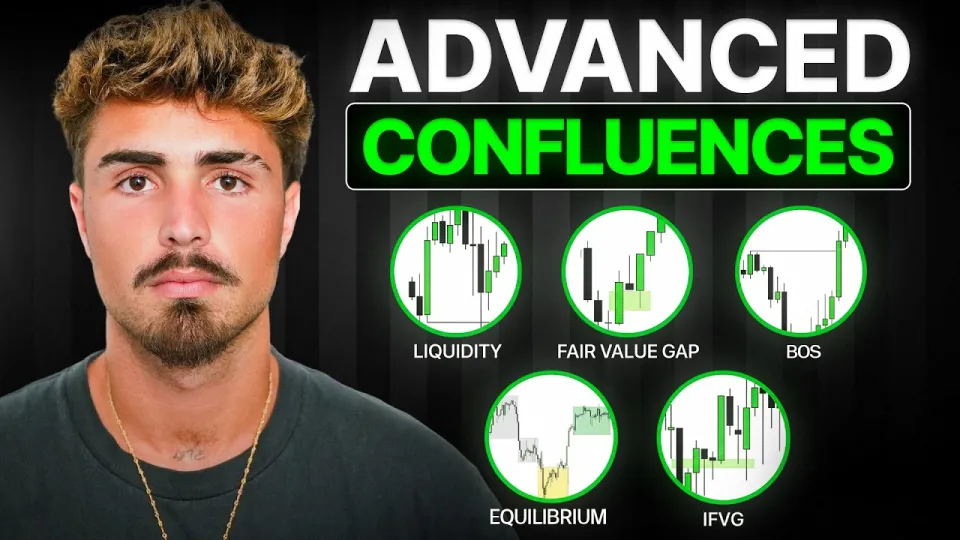
Video: Learn Every Trading Confluence In 18 Minutes
Want articles like this for your own video to promote it on YouTube and Google? Order them through the Telegram bot @sat_sit_bot. The bot writes and publishes the articles itself (with your YouTube video embedded) on popular topical websites (no ads). Try it free: 50 articles on us.
Trading confluences are independent pieces of evidence — liquidity sweeps, fair value gaps, inverse fair value gaps, equal highs and lows, and break of structure — that line up at the same price and time before you take a position. TJR's 18-minute walkthrough compresses those five concepts into one framework, and the full system behind it is available through the TJR blueprint. The point is not to collect signals but to decide in advance which ones actually improve your entries.
What a confluence is and why one signal is rarely enough
A confluence is a second, independent reason to take the same trade, and its job is to raise the probability that the level you are watching gets respected. A single fair value gap on a 5-minute chart is a weak reason to click buy; the same gap sitting behind a swept low, aligned with the daily bias, and confirmed by a break of structure is a different proposition.
The logic is statistical rather than magical. Each condition filters out a slice of losing scenarios, so the remaining sample is smaller but cleaner. That is also why more confluences is not automatically better: every added filter cuts the number of trades, and past a certain point you are just curve-fitting noise. Traders who treat confluence as a checklist of ten boxes usually end up with analysis paralysis and no entries at all.
A workable rule is to pick a small fixed set — typically two or three — and require all of them every time. Consistency in what you demand from a setup matters more than the specific combination you choose.
Liquidity: the fuel that makes levels matter
Liquidity in this framework means clusters of resting orders — stop losses and pending entries — sitting above swing highs or below swing lows, which large participants need in order to fill size. Price is drawn toward those pools because that is where transactions can happen without excessive slippage.
Practical use looks like this:
- Mark recent swing highs and lows on the higher timeframe; these are the obvious pools.
- Note equal highs or equal lows, because retail stop losses stack there in a tight band.
- Wait for price to reach the pool and react — a sweep that takes the level and rejects is information; a clean break through is a different scenario entirely.
- Only then look for your entry model inside the reaction.
A liquidity grab on its own tells you where the market went, not where it is going. It becomes a confluence when it coincides with a level you already wanted to trade.
Fair value gaps and inverse fair value gaps
A fair value gap is a three-candle imbalance where the wicks of the first and third candles do not overlap, leaving a price range that traded in one direction with little two-sided participation. Many traders treat the gap as an inefficiency that price may return to before continuing.
An inverse fair value gap is the failure case: price returns to the gap and instead of respecting it, closes through it and treats it as support or resistance in the opposite direction. That flip is often the more useful signal, because it shows the imbalance being absorbed rather than defended.
How to apply both without overcomplicating:
- Use the gap as an area, not a precise line; entries at the edge of the range with a stop beyond the far side keep risk defined.
- Prefer gaps that formed during an impulsive move away from a liquidity sweep.
- When a gap inverts, update your bias instead of defending the original idea — the market has just shown you who was trapped.
- Avoid stacking three gaps from three timeframes; pick the one that sits at a level you already care about.
Equal highs, equal lows and break of structure
Equal highs and equal lows are repeated tests of the same price, and they matter because they advertise where stops are parked. A double top that everyone can see is a target, not a wall. Treat equal highs as a liquidity magnet and expect either a sweep through them or a failure that traps breakout buyers.
Break of structure is the confirmation step: price takes out a meaningful swing point in the direction of your bias, which suggests the prior sequence of lower highs or higher lows has ended. The value comes from combining the two — a break of structure that happens right after a sweep of equal lows is far more informative than a break in the middle of nowhere.
Sequence matters here. Sweep, then displacement, then break of structure, then a return into the gap left behind is the classic order of events. If you find yourself entering before the sweep, you are trading a prediction rather than a confluence.
Common questions traders raise about confluence stacking
Viewers of the breakdown repeatedly ask the same practical things, and they are worth answering directly. The first is whether every confluence must be present. No — a fixed, small set that you can execute under pressure beats a long checklist you abandon after two losses.
The second is how to know which confluences actually add value. The honest answer is measurement: log your trades by setup type, tag which conditions were present, and compare win rate and average risk-to-reward across groups. A confluence that does not improve either number over a few hundred trades is decoration. The third recurring theme is the emotional side — traders describe needing to lose money and stay consistent before anything clicks, and that matches what the data usually shows for beginners. Discipline and risk control decide survival; confluence selection only decides which trades you take.
The fourth is skepticism about manipulation and about social-media results. Both concerns are reasonable. Markets are adversarial, and screenshots of fast account growth are not evidence of a repeatable process. Treat every claim, including the ones in the video, as a hypothesis to test on your own journal.
How to build a confluence checklist you will actually follow
A useful checklist is short, written down, and tested, and it fits on a sticky note rather than a spreadsheet. Start by choosing one higher-timeframe bias method, one liquidity condition, and one entry trigger — for example a fair value gap or an inverse fair value gap.
Then run it in three stages:
- Backtest by hand on 100 charts, tagging each trade with the conditions present.
- Forward test on a demo or small size for at least a month, recording risk-to-reward and win rate per setup tag.
- Cut anything that does not separate winners from losers, then trade only the survivors for a fixed period before changing anything again.
Add position sizing and a daily loss limit to the same document, because a perfect confluence list with no risk rules still ends in a blown account. Most funded-account programs and prop firms enforce drawdown limits that punish exactly the overtrading that extra confluences encourage, so the checklist should include a maximum number of trades per session.
Useful links
- TJR blueprint — the full system for becoming a consistently profitable trader
- Indicators TJR uses daily
- Funded account raffle entry
- Alpha Futures funded accounts — 10% off
- Lucid Trading — 40% off
Final thoughts on turning confluences into a process
The 18-minute breakdown is a map, not a strategy: it names the concepts — liquidity, fair value gaps, inverse fair value gaps, equal highs and lows, break of structure — and leaves the filtering to you. Pick two or three of them, write the rules down, and measure whether they actually improve your numbers before adding anything else. Channel TJR is the author of the original walkthrough, and the blueprint is where the full framework lives if you want the structured version. Day trading is risky and most retail traders lose money, so size positions as if the next trade is the one that tests your discipline.
Key takeaways
- Confluence means stacking independent signals (liquidity, FVG, IFVG, equal highs/lows, break of structure) before risking capital.
- TJR's 18-minute breakdown covers five core concepts: liquidity, fair value gap, inverse fair value gap, equal highs/lows, and break of structure.
- A confluence only adds value if it fits your existing strategy — stacking signals without a thesis just produces overtrading.
- More setups is not the goal: one or two high-quality confluences per session usually beats ten marginal entries.
- Most retail day traders lose money; funded-account and broker links in the video are affiliate promotions, not performance proof.
Questions & answers
What exactly is a trading confluence?
A confluence is a second independent reason that supports the same trade idea, such as a liquidity sweep lining up with a fair value gap and a break of structure. It is used to filter setups, not to guarantee outcomes. Two or three well-chosen conditions are usually enough.
How many confluences should I require before entering a trade?
Most traders do better with a small fixed set of two or three conditions that they apply every time. Adding more filters shrinks the sample of trades and can turn into curve-fitting, so measure whether each new condition actually improves your win rate or risk-to-reward.
What is the difference between a fair value gap and an inverse fair value gap?
A fair value gap is a three-candle imbalance where the first and third candles' wicks do not overlap, leaving an untraded range. An inverse fair value gap is what happens when price returns to that range and closes through it, flipping it into support or resistance in the opposite direction.
Is it realistic to become profitable quickly with these setups?
No. Most day traders lose money, and screenshots of fast account growth are not evidence of a repeatable process. Expect to spend months journaling, backtesting and forward testing on small size, and treat discipline and risk control as the factors that decide survival.
Source: Learn Every Trading Confluence In 18 Minutes · Markdown version